
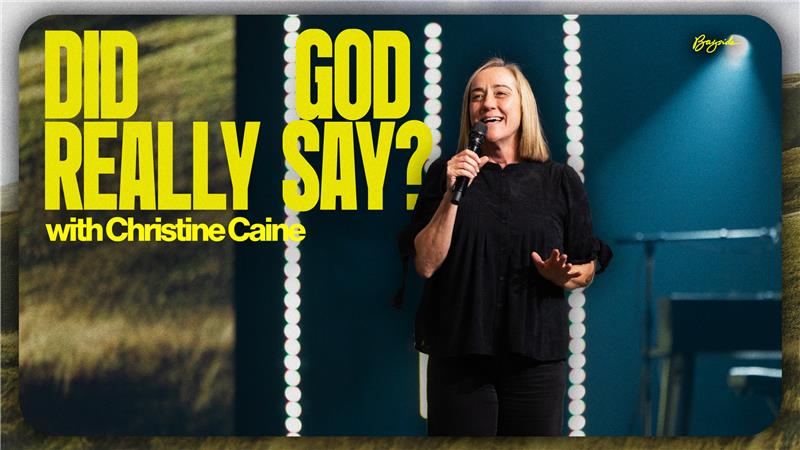
Breaking Free from Shame and Living in Truth
We live in a world filled with noise — voices that question, challenge, and twist what God has said. Every scroll, comment, and conversation seems to echo that ancient whisper first heard in Eden: “Did God really say?” It’s more than a question; it’s an invitation to doubt the goodness of God, the truth of His Word, and the worth of who we are.
The battle that began in Genesis 3 is still being fought in our minds and hearts today. But the good news is this — the same God who sought Adam and Eve in the garden still seeks us now. He calls us out of hiding, out of shame, and back into the truth that sets us free.
The Lie That Changed Everything
In Genesis 3:1, the serpent asks Eve, “Did God really say, ‘You must not eat from any tree in the garden’?” It’s subtle. The enemy doesn’t deny God’s existence — he distorts His Word. He twists what God said just enough to plant doubt in Eve’s heart.
That same tactic is alive today. The enemy doesn’t usually try to convince us that God isn’t real — he tries to make us question what God said about our identity, our purpose, and our future.
- Did God really say you’re forgiven?
- Did God really say He has a plan for you?
- Did God really say you’re loved, even after what you’ve done?
Every time we believe the lie, we take a step away from truth and a step closer to shame. That’s the serpent’s goal — not just to get us to sin, but to make us feel unworthy of ever walking with God again.
The Birth of Shame
Before the fall, Scripture says, “Adam and his wife were both naked, and they felt no shame” (Genesis 2:25). They lived in perfect freedom — no hiding, no pretending, no fear of rejection. But once they believed the lie, everything changed. Shame entered the world.
Shame is different from guilt. Guilt says, “I did something wrong.” Shame says, “Something is wrong with me.” It’s the voice that keeps us from drawing near to God, whispering that we’re too far gone, too broken, too dirty to ever be made whole again.
But shame was never God’s design. It’s the toxic fruit of believing lies about who we are. And while the enemy uses shame to separate us from God, Jesus came to close that distance — to clothe us in righteousness and restore what was lost in the garden.
God’s Question: “Who Told You?”
When Adam and Eve hid, God called out, “Who told you that you were naked?” (Genesis 3:11). He didn’t ask because He lacked information — He asked to bring them back to the truth.
That question still echoes to us today.
Who told you that you weren’t enough?
Who told you that your past defines your future?
Who told you that you’re too broken for God to use?
The world, culture, and even people we love can speak lies that take root in our hearts. But the Father’s voice cuts through the noise. His Word reminds us that we are fearfully and wonderfully made (Psalm 139:14), chosen and adopted into His family (Ephesians 1:5), and created in Christ Jesus to do good works (Ephesians 2:10).
Our healing begins when we replace every false word with God’s truth.
Truth Stronger Than Trauma
There’s a moment when the pain of our past collides with the power of God’s truth. Many of us, like Eve, have eaten the fruit of deception — believing lies about our worth or identity. Yet God never leaves us there. He meets us in our hiding places and covers us with His grace.
The facts of our lives may be painful — broken relationships, abuse, rejection, or regret — but facts are not the final word. God’s truth is greater than the facts. His Word doesn’t deny what happened; it redefines who we are in light of it.
You may have been abandoned, but God says, “I will never leave you nor forsake you” (Deuteronomy 31:6).
You may feel forgotten, but He calls you chosen.
You may carry shame, but He calls you redeemed.
The voice of truth speaks restoration where the world sees ruin.
Living by Every Word God Has Spoken
The serpent’s question — “Did God really say?” — still challenges us daily. Culture invites us to create our own truth, to live by our feelings instead of our faith. But Jesus Himself reminded us, “Man shall not live on bread alone, but on every word that comes from the mouth of God” (Matthew 4:4).
To live in freedom, we must know and trust what God has said. His Word isn’t just a comfort; it’s a weapon. When the enemy whispers lies, Scripture becomes our defense. When we don’t know what’s true, we return to what’s eternal.
Truth isn’t relative — it’s relational. It’s found in the person of Jesus Christ.
The Power of a Father’s Words
There’s a beautiful moment when a child chooses whose voice to believe. When someone tells a young girl she isn’t good enough, and she replies, “My daddy says I’m beautiful,” you can feel the authority of love silencing the lie.
That’s the posture God invites us into — to hear the world’s accusations and respond with, “My Father says…”
- My Father says I am loved (Romans 8:38–39).
- My Father says I am chosen (1 Peter 2:9).
- My Father says I am free (John 8:36).
When we anchor our identity in the voice of our Father, every other voice loses its power.
From Shame to Strength
You were never meant to hide. You were never meant to question your worth. God’s truth is not fragile — it’s unshakable. And it’s waiting for you to believe it again.
Whatever the enemy has used to silence you, God wants to use to strengthen you. Your past does not disqualify you; it prepares you. Your wounds can become weapons of hope when surrendered to the One who heals.
So when you hear that whisper — “Did God really say?” — stand firm in the truth of His Word. Yes, He did. He really did say you’re loved, chosen, and called for such a time as this.
Get Connected at Bayside Church
If you’re ready to grow deeper in your faith, surround yourself with truth, and be part of a community that helps you live it out, we invite you to get connected at Bayside Church. Join one of our ministries, serve with us, or bring your family to our upcoming Trunk or Treat event! We’d love for you to decorate a trunk, meet new people, and share the joy of Jesus with our community.
At Bayside, there’s always a place for you — a place to belong, believe, and become everything God says you are.

Leave a Reply